Why the PP and PPCP distinction matters
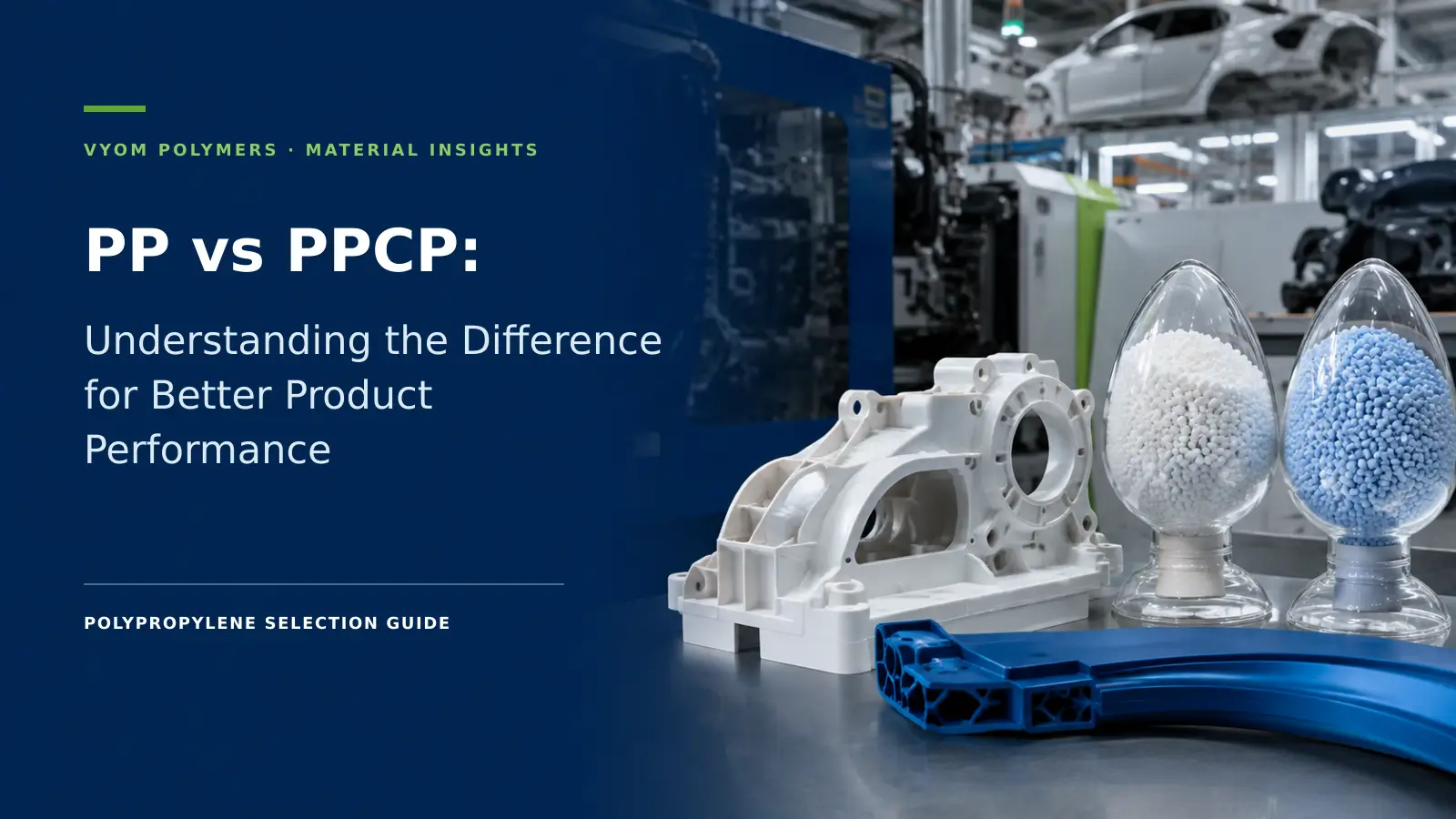
Polypropylene is valued across manufacturing because it offers low density, chemical resistance, fatigue resistance and efficient processing. Yet the term PP can refer to different polymer structures. Two commonly discussed options are PP homopolymer and polypropylene copolymer, particularly polypropylene impact copolymer or PPCP.
Both materials belong to the polypropylene family, but they do not deliver identical performance. Selecting one only on price or availability can lead to brittle parts, unnecessary flexibility, dimensional issues or over-engineered products. The decision should be based on impact requirement, stiffness, temperature, appearance, processing method and product design.
What is PP homopolymer?
PP homopolymer is produced primarily from propylene monomer. Its relatively regular structure gives it high stiffness, good tensile strength and a clean surface finish. It is frequently used where rigidity, lightweight construction and repeatable moulding are central requirements.
Applications can include household articles, caps and closures, appliances, thin-wall packaging, fibres, woven sacks, stationery and numerous injection-moulded components. Specific grades are developed for injection moulding, extrusion, raffia, thermoforming and other processes.
Typical PP homopolymer advantages
- High stiffness-to-weight ratio
- Good surface finish and colourability
- Strong fatigue resistance for living hinges
- Good resistance to many chemicals
- Efficient processing across multiple conversion methods
What is PPCP?
PPCP commonly refers to polypropylene copolymer, often an impact copolymer containing a controlled rubber-like ethylene-propylene phase. This modification improves toughness and impact resistance compared with PP homopolymer. It is especially valuable in parts exposed to drops, vibration, rough handling or lower service temperatures.
PPCP is widely considered for automotive components, luggage, battery cases, crates, industrial containers, appliance parts and durable moulded products. The added toughness may come with lower stiffness or surface gloss than a comparable homopolymer, so the material must be chosen around the part’s dominant performance need.
Typical PPCP advantages
- Improved impact resistance
- Better toughness at lower temperatures
- Suitable for durable and load-bearing moulded parts
- Good chemical and moisture resistance
- Available in multiple impact and melt-flow combinations
PP vs PPCP: the key selection factors
Stiffness: PP homopolymer normally provides greater rigidity, which benefits thin-wall components, packaging and parts that must hold their shape. PPCP sacrifices some stiffness to deliver better toughness.
Impact performance: PPCP is the stronger choice where products may be dropped, struck or used in colder conditions. Standard PP can become comparatively brittle when the impact demand exceeds the grade’s capability.
Appearance: PP homopolymer often offers better gloss and a cleaner surface. PPCP can still provide an attractive finish, but highly aesthetic components should be validated with the selected grade, colour masterbatch and mould texture.
Processing: Both families are widely injection moulded and extruded. Melt flow should be selected according to wall thickness, tool design, cycle time and mechanical targets. A higher-flow grade can fill complex or thin sections more easily, but the final mechanical balance must be confirmed.
Cost and material efficiency: The lowest resin price does not always result in the lowest component cost. A material that reduces breakage, rejects or excessive wall thickness may improve overall economics even when its purchase price differs.
Application-based guidance
- Thin-wall containers and rigid household goods: begin by evaluating PP homopolymer
- Automotive trims and functional parts: evaluate PPCP when impact is important
- Crates, luggage and durable containers: PPCP is often preferred for toughness
- Woven sacks and raffia: use an application-specific PP raffia grade
- Caps, closures and living hinges: select PP grades designed for fatigue resistance and moulding consistency
- Cold-service products: validate low-temperature impact performance before approval
Frequently asked questions
Is PPCP the same as PP?
PPCP belongs to the polypropylene family, but it is a copolymer designed to deliver a different balance of impact strength, stiffness and temperature performance than PP homopolymer.
Is PPCP always better than PP homopolymer?
No. PPCP is better when impact toughness is the priority. PP homopolymer may be more suitable when stiffness, surface finish or thin-wall rigidity matters more.
Can PP and PPCP be substituted directly?
Direct substitution is not recommended without evaluation. Differences in shrinkage, stiffness, impact strength, flow and appearance can affect the moulding process and final component.
What information is needed to recommend a grade?
Share the application, conversion method, part thickness, melt-flow requirement, impact and stiffness targets, colour, additives and any regulatory or test requirements.
Discuss your PP or PPCP requirement
Vyom Polymers supplies fresh and virgin PP and PPCP granules for packaging, household, automotive and industrial applications. Our team can help narrow suitable material options based on your process, performance target and procurement requirement.
Call +91 85951 49912 or email vyompolymer@gmail.com for product and supply enquiries.